Barry Eisler

Tuesday, May 14, 2013

Jeremy Scahill's "Dirty Wars"

Last week, I had the honor of hosting a Commonwealth Club discussion with premier investigative journalist Jeremy Scahill in which Jeremy discussed his new book, "Dirty Wars: The World Is A Battlefield."  You can listen to an audio of the one-hour talk here, and see some photos from the event here.


It's a Commonwealth Club tradition to ask participants at the end of a talk to name a 60-second idea for changing the world.  Jeremy's, I thought, was profound:  American kids should be assigned essays in which they would research and report on the lives of innocent people killed in America's drone wars.  The president personally eulogized the three people killed in the Boston bombing, yet we almost never hear the stories or see the faces of the innocent lives our wars cut short (well, in fairness, according to the Obama administration, it's not possible for someone killed by an American drone to be innocent).  Imagine how different the world might be if we were to deny ourselves the luxury of that ignorance.


I don't blurb many books (here's why) but I was honored to blurb Dirty Wars.  Here's what I said:

"Dirty Wars is the most thorough and authoritative history I've read yet of the causes and consequences of America's post 9/11 conflation of war and national security. I know of no other journalist who could have written it:  For over a decade, Scahill has visited the war zones, overt and covert; interviewed the soldiers, spooks, jihadists, and victims; and seen with his own eyes the fruits of America's bipartisan war fever. He risked his life many times over to write this book, and the result is a masterpiece of insight, journalism, and true patriotism."

You can learn more about the book -- and about the accompanying film, which opens on June 7 -- at the Dirty Wars website.

Bookmark and Share

Sunday, May 12, 2013

Don't Worry, US Imperialism is Cost-Free

UPDATED BELOW

Recently I watched a terrific exchange between Glenn Greenwald and Bill Maher on Maher's show Real Time.  Maher was arguing that there's something peculiarly violence-prone about Islam; Greenwald countered (devastatingly, in my opinion) that Muslim violence is likely caused more by US imperialism than by anything intrinsic to Islam itself.


This led to an odd post by David Atkins at the excellent blog Hullabaloo (Digby, who runs Hullabaloo, has her own response to Atkins here) in which Atkins argues that because we haven't seen in other countries and cultures subjected to US imperialism the kinds of reactions we've seen in the Islamic world, it means Islamic violence is not being caused by US imperialism -- quod erat demonstrandum.

There's something that's been bugging me about Atkins' post (bugging me beyond the fact that he attributed to Greenwald something that not only did Greenwald not say -- "Imperialism is to blame for everything" -- but that Greenwald specifically and repeatedly disclaimed).  What's been bugging me is Atkins' logic.  Or, more precisely, his lack of it.

I tweeted that the shorter version of Atkins is "If blowback doesn't happen everywhere, it can't happen anywhere," and that's part of what I find illogical about his overall argument.  But here's another way of understanding it.

Suppose I walked up to a dozen people at random and spit in each of their faces.  Maybe some of them would ignore me.  A few might cry.  Others might spit back.  Some might sue.  Some might respond with their fists.  Some might respond with lethal force.  A few might even track down my family members and kill them to teach me a lesson.

The point is, my spitting would likely provoke a range of reactions, each of them different on the surface (different people, like different cultures, will respond to the same stimulus in a variety of ways), but all of them having in common the fact that each is a reaction to my spitting.

What Atkins is arguing is that if some of the people I spit at did nothing significant in response, it means the behavior of the other people must have nothing to do with my spitting.  But this makes no sense, neither the methodology nor the result.  The proper way for Atkins to test his thesis would be ask, "The one guy who went after my family after I spit in his face, even though the other eleven people reacted differently… would he have done so had I not spit in his face?"

(And look, let's not get too sidetracked by my spitting analogy, all right?  Even if you believe that when America supports dictators, and invades, occupies, and drones other countries, it is doing nothing other than protecting these benighted cultures from their own savagery and magnanimously gifting these countries with the blessings of freedom and prosperity, you can't seriously argue that the recipients of these gifts will view them as you do.  In other words, I'm arguing here not about US intentions, but about perceptions of US actions by the people on the other end of those actions).

This is pretty basic, is it not?  If someone theorizes that "Y is being caused largely by X," the most obvious and logical way to test the theory is to remove X, and see if Y persists.  On some level, I think Atkins realizes this.  He mentions America's experience in Vietnam, after all.  There, Vietnamese violence against western forces ceased when western forces departed.  Yet judging from Atkins' conclusions, it's as though he believes the Vietnamese cessation of violence was just a coincidence and had nothing to do with America's withdrawal.

So the question Atkins should really be asking -- and it's so obvious as a matter of logic I can't help wonder what's preventing him from asking it -- is this.  If America withdrew its support for dictators in the Muslim world, and withdrew its military forces from the Muslim world, what would be the likely effect on Muslim violence against the west?

The only reason to avoid asking this question is that the answer is so obvious -- and so obviously uncomfortable for anyone intent on arguing for the benefits of imperialism while determined to deny its costs.

If there's one thing I find continually strange about political discourse in America (actually, there are many things, but this is a big one), it's naiveté -- naiveté to the point of denial.  I would respect (though I would disagree with) an argument such as, "The world is a messy, dangerous, chaotic place.  It needs a strong policeman to enforce rules and order, and that policeman is America.  Certainly many people will resent America's self-appointed role as policeman, and among them some will react violently.  But violence in response to our policing is just a cost of doing business, a cost worth incurring if we're to secure the overall benefits our policing entails."

Instead, what we're continually fed -- and what many people eagerly ingest -- is a self-serving narrative about how they hate us for our freedoms and/or how violence against America is intrinsic, innate, and spontaneous among the people who engage in it (don't you love that phrase "self-radicalized," for example, as though someone is sitting quietly in a room and just -- poof! -- suddenly becomes a radical, all by himself?).  According to this narrative, violence against America never has anything to do with American behavior.  If there's an example of psychological denial more profound than this, I'd like to know what it is.

(I'm not talking specifically about Atkins in the paragraph above -- these aren't his arguments, and in fact he explicitly argues that Islam seems no more violent than various other religions.  But what he does argue is that violence against America is primarily caused by something other than American behavior -- according to Atkins, fundamentalism).

After the last ten years, if they really hated us for our freedoms, don't you think they'd hate us a bit less by now?  With two successive presidents claiming the right to imprison people indefinitely without charge, trial, or conviction, and to spy on Americans without warrants, and with our current president claiming in addition the power to execute American citizens without any recognizable due process, we have a lot less freedom to hate.

I guess we just haven't given up enough freedom for them to stop hating us.  We really should give up even more.

Or, instead, we could try invading, occupying and droning Muslim countries a little less, and see if that helps.  Maybe prop up fewer corrupt and tyrannical Muslim regimes.

Nah.  Islamic violence against America has nothing to do with any of that.  It's all hatred of our freedoms, or something innate to Islam, or it's just that violence is what fundamentalists do.  I mean, people never react violently to violence.  After all, look how calmly and rationally America responded to 9/11.

The most amazing thing about this topic?  That it even needs to be discussed.  Martin Luther King pointed it out almost fifty years ago, when he described America as "The greatest purveyor of violence in the world today."  Violence carries terrible costs.  We ought to accept those costs, not deny them.  Not least because the denial is such a large part of what enables the violence.

UPDATE:  Shame on me for not linking to this excellent post by actual middle east expert Juan Cole on Islamic violence and violence we might attribute to other religions.
Bookmark and Share

Monday, April 29, 2013

More on Digital Denial

Here's an article the Guardian asked me to write after the brouhaha over my Pikes Peak Writers Conference keynote:

The Digital Truths Traditional Publishers Don't Want To Hear

Enjoy.
Bookmark and Share

Monday, April 22, 2013

Guest Blogging and Talking Like Dox

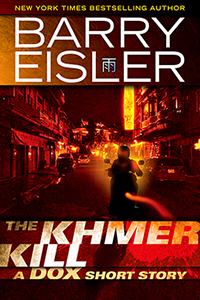
This week I'm talking like Dox -- with Brilliance Audio, narrating the audiobooks for The Khmer Kill, London Twist, and my first novel, A Clean Kill in Tokyo.  So much fun, though man, narrating a book is draining!  Will let you know when they'll be available.  In digital download, it ought to be soon.

Meanwhile, I'm guest-posting at Joe Konrath's blog A Newbie's Guide to Publishing.  Topic:  Digital Denial at the Pike's Peak Writers Conference.  Also don't miss the excellent follow-up by Porter Anderson at Publishing Perspectives.

Y'all have a good evening, now.

(Sorry.  Still in character. ;))
Bookmark and Share

Wednesday, April 10, 2013

Scott Turow and the Politics of Cowardice

Guest blogging at A Newbie's Guide to Publishing today:  Scott Turow and the Politics of Cowardice.  Shockingly, no response from Mr. Turow.
Bookmark and Share

Monday, March 25, 2013

That Power of Accurate Observation Is Called Political By Those Who Have Not Got It

I'm glad to say that most of the Amazon customer reviews for my new short novel, London Twist, have been positive.  Among the negative ones, there's an interesting theme:  that the story is either disturbingly pro-gay or disturbingly anti-drone, and in all events too liberal.  I think it's worth examining these claims, and the premises behind them.

1.  The Story Is Disturbingly Pro-Gay.  I suppose if someone in the story made a speech in favor of marriage equality, or if I depicted the unjust suffering of gays due to discriminatory laws, there might be a basis for the claim that the story is pro-gay.  In fact, the story involves (among other things) two straight women who, while circling each other on opposite sides of an espionage operation, find themselves attracted to each other, and wind up acting on that attraction.  It's hard for me to understand how depicting something like this could be pro-gay.  I'm guessing that some people find implicitly political a depiction of same-sex attraction and of gay sex itself?  In other words, if you don't try to deny the existence of homosexuality, or if you don't try to depict homosexuality in a negative light, you're doing something political.

There might actually be something to this view.  Because if marginalizing gays in fiction is political, then mainstreaming them must be political, too.  If depicting gay sex as immoral and unhealthy is political, then depicting it as normal and healthy must be political, too.

What's revealing, though, is that I don't think I've ever read a critique of a story that has no gay elements as "too pro-straight" or as "anti-gay."  I doubt, for example, that anyone has ever posted the "it's too straight" equivalent of this reviewer's thoughts:  "Eisler's usual good work. But I get a little bit tired of the social cheer leading for gays.  I hear and read enough of that stuff already."

I think what causes this odd reaction is this:  Prevailing political prejudices are rarely recognized as political at all -- an insidious blindness that permits one side to attack the other as "political" when in fact a more honest criticism would be "political in a manner that differs from my politics."  So if you're straight and would prefer to live in an all-straight world, fiction devoid of gays won't feel political to you.  It'll feel normal, comforting, a reflection of the world you take to be true.  But fiction with gay characters or gay sex?  Political!

By the way, I have to add that the odd phrase "pro-gay" is my attempt to paraphrase some of what's been written about the story.  In fact, I don't think of myself as pro-gay any more than I think of myself as pro-straight.  What I am is pro-equality-before-the-law.  And while certainly that means I'm not anti-gay (I'm not anti-straight, either), some people have a worldview in which if you're not anti-gay, you're pro-gay -- one more manifestation of the condition in which someone is blind to his own politics and finds "politics" at work only in those who disagree with or otherwise challenge his implicit assumptions.

2.  The Story Is Disturbingly Anti-Drone.  I have an easier time understanding the basis for this claim than I do for the "pro-gay" one.  After all, one character, Fatima, a Pakistani living in London who lost her two younger brothers as "collateral damage" in a drone strike, gives a speech at an anti-drone rally, and two other characters -- a Mossad operative and an MI6 operative -- discuss the way drone warfare increases hatred for the west.  So here, at least, critics can point to something more political than the mere possibility of a same-sex attraction or the depiction of gay sex.

But is it really particularly political to create a character who lost two brothers in a drone strike and is motivated to take revenge as a result?  After all, it's simply a fact that drone strikes kill civilians.  And it's simply a fact that making war on Muslim countries increases hatred against the west, as a 2004 Pentagon study, undertaken at Donald Rumsfeld's direction, concluded (did we really need an official study to figure out that bombing, invading, and droning people makes them hate us?  Apparently so).  Now, you can logically (if not persuasively) argue that the civilian deaths and hatred of the west are worth it, but you can't reasonably argue that the civilian deaths and hatred don't exist.  So I can only conclude that people who favor drone strikes as a response to our fears of terrorism would prefer to deny that drone strikes cause civilian deaths and hatred, and that such people therefore feel that to acknowledge that drone strikes in fact do cause civilian deaths and do produce hatred is to do something remarkably political.

Again, I wonder:  are stories depicting brown-skinned, dark-bearded Islamic fanatics trying to slaughter innocent Americans solely because they hate us for our freedoms typically criticized for being too political?  Not that I'm aware of.  And this is so because the "we're blameless, they hate us for our freedoms" narrative is the prevailing narrative in America today (easy to peddle because it flatters and comforts its audience), and because prevailing narratives aren't viewed as "political" by the people who've adopted them, but rather simply as "truth."  Only people who challenge that "truth" are guilty of committing politics.

In fairness, I think you could argue that any depiction in a novel of the causes of terrorism will be inherently and unavoidably political.  But what's interesting, again, is that charges of "too political" are typically leveled only in one direction.  What's even more interesting is *which* direction.  Because while there is actual, empirical, Pentagon-sponsored evidence in favor of the incredibly obvious proposition that people who are bombed, invaded, and droned tend to hate the people doing the bombing, invading, and droning, there is no evidence I'm aware of for the proposition that our policies have no causal connection to terrorism and that terrorists simply hate us for our freedoms.  So between depicting something evidence-based, obvious, and accurate on the one hand, and depicting an evidence-free, self-pleasuring fantasy on the other, which depiction is more fairly termed the "political" one?

It's enough to make you suspect that charges of "political!" might themselves be an insidious tool of propagandists, akin to charges of "bias" in journalism.  Because like bias -- which is just the accusatory form of the word "viewpoint" -- everyone's got politics, and there's really no way to avoid it.  Even trying to avoid being political is political.

But more commonly, I suspect what's going on is simply projection.  And more commonly still, just ignorance.  As the saying goes, "Never attribute to malice what can adequately be explained by stupidity."

3.  The Story Is Disturbingly Liberal.  This is another one that's a little hard to figure out, given the absence from the novella of anything about abortion rights, a decent minimum wage, universal health insurance, or other such classical liberal issues.

Instead, at the heart of the story is an Israeli spy whose assignment is to get close to a Pakistani woman, learn the whereabouts of the woman's brother, and provide the brother's location to western governments so he can be killed.  During the course of that assignment, the spy increasingly comes to care about the woman and to feel increasingly ambivalent about the devastation her own actions will cause to the woman and the woman's family.  I'm not sure what would be liberal about such a storyline, but my guess is that anything that acknowledges the humanity of The Other, or that otherwise might render The Other sympathetic, is at the heart of this particular political transgression.  Or perhaps it's unacceptably political to depict any ambivalence on the part of western spies and soldiers about the morality of their means and the efficacy of their ends?  If so, you'd have to argue that only depictions of spies and soldiers untroubled by conscience can be deemed non-political.  To paraphrase Oscar Wilde, I'd call a story like that worse than unrealistic.  I'd call it boring.

And of course it would still be political, too.

It's not that I don't think my stories are political.  They are -- that's why I call them political thrillers.  It's just that they're no more political than are stories faithfully depicting prevailing political narratives.  And while I don't mind my novels being criticized for being political, I do hope that people will recognize that on some level, probably *all* stories are inherently, unavoidably political, and that criticizing someone else's politics for being "political" while believing your own politics are nonexistent betrays an unfortunate lack of candor, or, more likely, a lack of self-awareness.

Another paraphrase, this one of George Bernard Shaw, who was referring to cynicism:  "That power of accurate observation is called political by those who have not got it."
Bookmark and Share

Tuesday, February 19, 2013

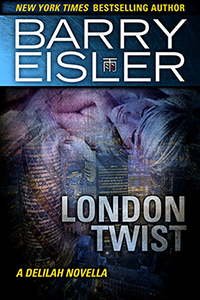
London Twist, Available Today!


Hi everyone, I’m beyond excited (what is beyond excited, anyway?  Ecstatic?  Delirious?  Orgasmic?  Maybe all of the above) to share two big announcements today.  First, my new Delilah novella, London Twist, is available at last; second, my publishing contracts for my first eight novels have been amicably terminated and all rights reverted to me!

Here’s more about London Twist, published by Thomas & Mercer and available exclusively from Amazon (and available in the UK Kindle Store, too):

For Delilah, the Mossad’s top seductress, the parameters of the assignment were routine.  The contractor:  MI6.  The objective:  infiltrate a terror network, this one operating out of London.  The stakes:  a series of poison gas attacks on civilian population centers.

There’s just one wrinkle.  The target is a woman—as smart, beautiful, and committed as Delilah herself.  And for a cynical operative thrust suddenly out of her element, the twists and turns of the spy game are nowhere near as dangerous as the secrets and desires of the human heart.


This story is approximately 36,000 words—the equivalent of about 145 paper pages.  It is a novella, not a novel.

And hey, no skipping to the dirty parts.

For now, London Twist will be available exclusively in digital.  Here are my reasons why, along with information on how to read the novella if you don't have a Kindle.

As for the first eight novels, I’m thrilled to be publishing them with the titles and covers I’ve always wanted.  Why have I changed the titles and covers?  I thought you might ask...

What’s really great is that with my rights reverted, the Rain books will finally be available in digital outside the United States.  This is a huge win for Rain fans in the UK, Australia, New Zealand, and elsewhere—especially at a price of US$4.99 (or foreign currency equivalent).  If you care about more people reading, as I do, then you’ll want books available everywhere, at low prices, as soon as possible, in as many formats as possible.  Anything else comes at the expense of readers, authors, and the general public.  There’s a better way, and I’m proud to be part of it.

Stay tuned for one more big announcement in the coming months—I’m busting to tell you more, but for now, mum’s the word.  Thanks as always for all your support and for enjoying the stories!

Barry
Bookmark and Share